



 Monday, 11 March 2024 11:02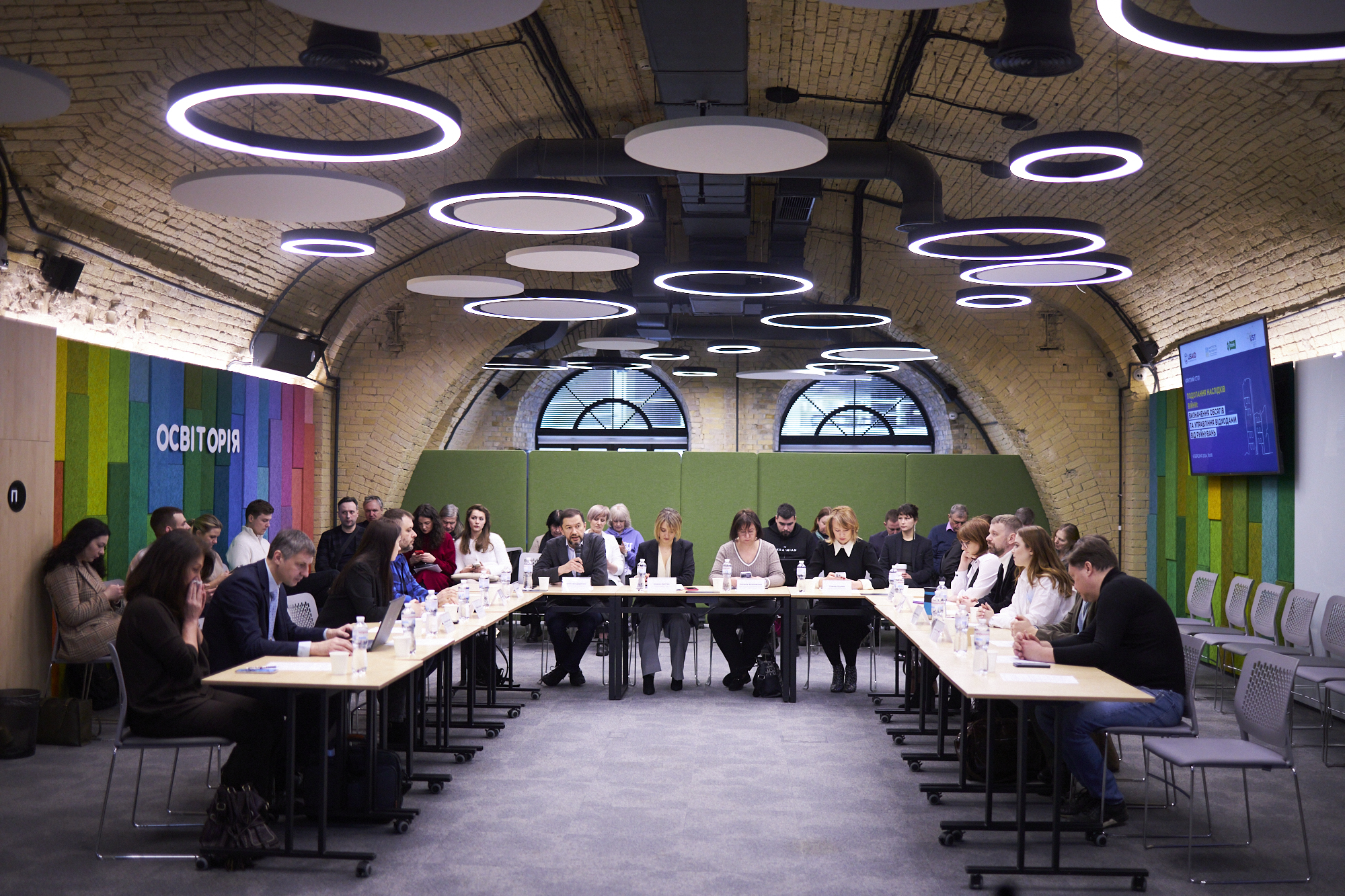
🌐On March 6, 2024, the Confederation of Builders of Ukraine took part in a roundtable discussion on the topic "Overcoming the consequences of war: determining the scope and management of waste from destruction", organized by the ReThink Public Organization, the Ukraine Support Team (UST) coalition, The Ministry for Communities, Territories and Infrastructure Development of Ukraine.

👤 From the CBU, Oleksandr Chervak, executive director of the CBU, joined the discussion.
👤Olena Koltyk, Head of the UST coalition, was the moderator. She noted that no one has a complete answer to the issue of waste from destruction management, and therefore it is necessary to collect all available experience.

👤Olena Shuliak, Head of the VRU Committee on State Building, Local Governance, Regional and Urban Development, Head of “Servant of the People”, informed about the necessary changes in construction legislation to optimize waste management processes.

👤Nataliia Kozlovska, Deputy Minister for Communities, Territories and Infrastructure Development of Ukraine, emphasized the need to create a high-quality document that communities can use: "First of all, you need to look at the existing regulatory framework (standards for manufacturing construction products and approaches to reusing components of building materials). Secondly, it is very important for us to understand how prepared - technically, not mentally - our manufacturers of construction products are for this kind of activity."
She noted the importance of taking into account the economic component, in particular the final cost of material, incentives for manufacturers, etc. Nataliia Kozlovska also noted that it is necessary to understand what percentage of the secondary raw materials must be used during construction: 3, 5, 10 or 20%.

👤Yevgenia Popovych, director of the Department of Digital Transformation Electronic Public Services and Waste Management of the Ministry of Environmental Protection and Natural Resources of Ukraine, informed about the specifics of hazardous waste management, in particular asbestos.
💬“We understand that asbestos was used very widely all over the world... But the situation in Ukraine is completely different. 60-70% of our ceilings and even fences are made of asbestos-containing slabs," Yevgenia Popovych noted.
She reminded that on September 6, 2022, the Law "On the Public Health System" was passed, which, among other things, prohibits the use of asbestos in construction. However, a decision must now be made on what to do with the existing asbestos.
💬"Thanks to international experts, in particular Swedish partners, rules for technical operation and construction were worked out. We will separate the place at the landfill, where we will place asbestos-containing waste in packaging. This is EU practice. There will be special requirements for such places," the director informed. She also noted that there are already two licensees who have the right to process asbestos-containing waste and have the necessary technical support.
👤Oleksandr Chervak presented the possibilities of using waste from destruction in new construction: "Business is ready to use secondary raw materials and to recycle waste. However, there is a problem of lack of necessary equipment in sufficient quantity, of highly qualified specialists and of development of appropriate technologies."
He noted that according to EU statistics, the construction sector consumes a significant amount of resources, accounting for approximately 50% of all extracted materials. At the same time, this sector is responsible for more than 37% of the total waste generation in the EU, making it one of the largest waste streams in Europe. Oleksandr Chervak noted that in many countries there are economic incentives to encourage companies to use secondary materials and reduce waste or additional taxes on the use of non-recycled materials. This practice is quite successful, but the main difference between waste in Ukraine and in the EU is its toxicity, since construction waste generated as a result of battles is saturated with toxic particles of gunpowder, electronics and batteries.
🌐In April, the Confederation of Builders of Ukraine will take part in the World Circular Economic Forum 2024, dedicated to the circular economy, where it will present the Ukrainian experience in processing and reusing building materials.

👤Roman Shakhmatenko, coordinator of the energy and environmental protection project group of UNDP, described the organization's work over the past few years in the field of waste management from destruction. He noted that since December 2022, 170,000 tons of demolition waste have already been removed in Ukraine. Currently, UNDP is working on the calculations of destroyed and damaged objects, determining the volumes of processing and the impact of this process on the economy.
📜Ihor Satin, an expert of the project "Rethink: Recommendations for the management of destruction waste in the front-line territories" presented the logic of future methodological recommendations for determining the volume of destruction waste in Ukraine. World experience was analyzed to find the optimal solution for Ukraine. The closest method is the Japanese one, since Japan constantly and for a long time suffers from natural disasters, but there is a significant difference due to climatic conditions.
👤Yumi Kimura, Director of the Department of Global Ecology, Team 2, Environmental Management and Climate Change Group of the Japan International Cooperation Agency (JICA), presented the experience of recycling and projects implemented in Ukraine, including a pilot project in the Kyiv region.
Also, during the round table, representatives of the regions presented their own experience and the main issues in handling waste from destruction.
👤Mykola Boyko, First Deputy Head of Kyiv Regional Military Administration, noted the need for equipment for processing. He noted that three processing lines are planned to be launched, and staff training is already underway. There is also the problem that the first waste was taken out unsorted.
👤Andrii Holovach, Head of the Kiyin community of Chernihiv region, presented how they started to sort waste on site. So, part of the waste was used to fill roads.
📊Iryna Kashpur, the Head of the Department of Environmental Protection and Natural Resources of the Sumy Regional State Administration, noted that due to continued shelling, 18 communities do not even have the opportunity to record the destruction. However, some communities still disassemble the destroyed, sort the waste from the destruction. In several communities they even immediately separate the asbestos-containing waste. However, in most cases, all construction waste is collected together. There are also issues of equipment and landfills that would meet all standards.
👤Yuriy Suyarko, Director of Utility Company “Kharkiv Municipal Company for Waste Management” of the Kharkiv City Council, listed the main problems: the location of landfills in the combat zone, the lack of capacity of shredders, the ability of equipment to process waste from destruction into such raw materials that can be used in the future, the duration the process of obtaining a license.
🧱Viktoria Spivak, head of the "Kovalska" Innovation and Technology Center, a member of the Board of Directors of the CBU, noted the possibility of manufacturing high-quality building materials from secondary raw materials using a scientific approach. She also emphasized the need to solve a number of problems in the processing of demolition waste, including toxicity, the need for sorting and determining the owner of the waste, regulatory support, as well as the willingness of manufacturers to modernize production lines for the use of recycled materials.
📜As noted by Anastasiia Bielohrad, head of the technical marketing and innovation department of CRH in Ukraine, a member of the Board of Directors of the CBU, it is important to understand what waste from destruction consists of, how its processing is regulated by existing National Standards of Ukraine and what opportunities exist for this process in Ukraine and in the world.
🏛️ Andriy Skrypnyk, acting director of the "Ukrainian Research and Design Institute of Building Materials and Products", presented the prospects of recycling demolition waste into building materials. In particular, he stated the requirements for raw materials for the production of recycled building materials and their main types.
The participants of the roundtable discussed the issue of waste management from demolitions and the possibility of their processing and reuse. The main issue was the provision of a regulatory and legislative framework, as well as the availability of equipment, technical expertise and economic incentives.


WE WILL WIN AND REBUILD EVERYTHING! 💪
TOGETHER TO VICTORY!
GLORY TO UKRAINE! 💙💛