



 Friday, 20 March 2026 15:00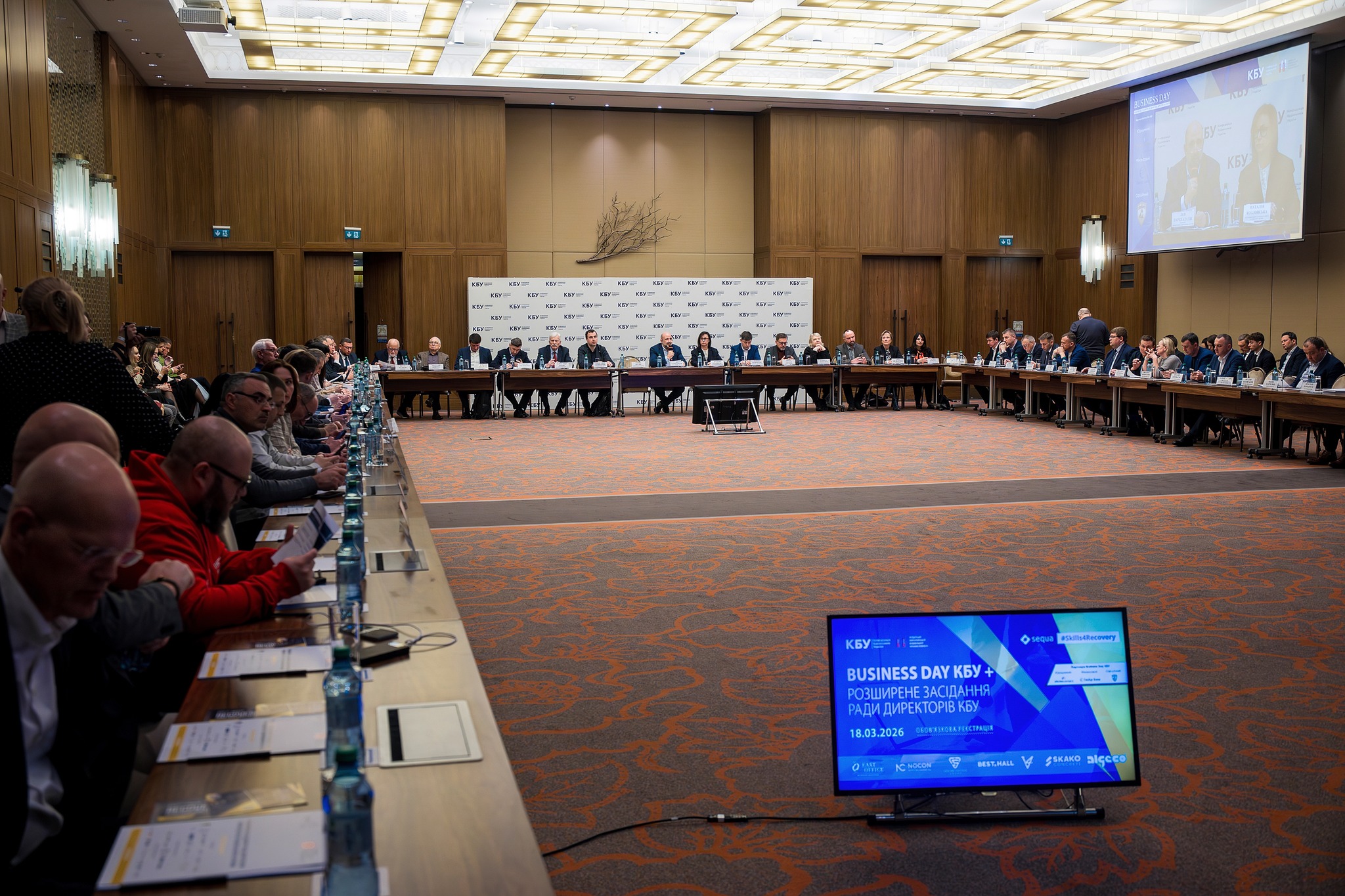
🏗️ New Tools for Transforming the Construction Industry
📌 Key changes in industry regulation, the implementation of digital tools, and the development of business energy self-sufficiency were discussed during the second session of the CBU Business Day, titled “Transparent Construction, Digitalization of Document Flow, and Energy Generation: Regulatory Developments and Financial Models”
The session was moderated by Oleksandr Chervak, CEO of the CBU, and Olga Sydorchuk, Chair of the CBU Committee on Legislative and Regulatory Affairs and a partner at the law firm Altelaw&Sempra.
💬 “Transparent construction, digitization of document flow, and power generation are extremely important, as they are the basic conditions for attracting investment and effective recovery. Only through transparent rules of the game, minimizing bureaucracy, advancing digitalization, and building a sustainable, autonomous power grid will we be able to implement the ambitious projects the country needs today”, said Roman Komendant, Deputy Head of the State Agency for Infrastructure Recovery and Development of Ukraine, in his opening remarks to the participants.
💬 Tetiana Korotka, Deputy Business Ombudsman, emphasized the importance of properly organizing processes: “International experience shows that it is not digital platforms as such that provide a positive effect, but systematically built processes that are then digitized. The construction sector is a prime example of precisely this approach.”
📲 Oleksandr Novytskyi, Head of the State Inspectorate of Architecture and Urban Planning of Ukraine, presented the “Transparent Construction 3.0” digital reform, which transforms the interaction between the state and business and shifts construction oversight from a manual to a clearly regulated digital process."
Version 3.0 also provides for expanding the circle of participants in the process - the construction client is fully integrated into the system as a participant in quality control. Additionally, a mechanism for preliminary inspection of the site is being introduced, which allows for the identification and elimination of deficiencies even before the official submission of documents, thereby increasing the success rate of the procedures. The app also allows for recording the inspector’s geolocation during the inspection, taking photos of the site, generating documents based on inspection results, and immediately uploading them to the Unified Electronic System for State Construction Supervision (UESSCS).
In addition, the system lays the groundwork for automating certain procedures, including the implementation of automated registration of certificates of acceptance into operation for the simplest types of facilities.
💬 “Ukraine has every chance of becoming one of the most successful countries in the construction sector - and the key to this is digitalization and the establishment of clear and equitable rules for all market participants. Our common goal is for business to operate freely: without unnecessary bureaucracy, without corruption risks, and with high-quality service from the state. The state must be a partner that provides convenient, transparent, and effective services—just as businesses provide service to their customers. “And we will continue to initiate and implement such solutions to make this a reality”, emphasized Mr. Oleksandr.
🎖️ During the session, letters of appreciation were presented to companies that actively supported the reform.
Participants paid special attention to the issue of digitizing document flow. Oleksiy Dorogan, Executive Director of the BRDO Office of Effective Regulation, emphasized the need to review approaches to the use of certificates of completion, which often create additional barriers for businesses: “Today, form often takes precedence over substance. Due to the culture of using certificates of completion, payments may be made with violations, and the process itself is complicated by excessive bureaucracy.”
💾 He noted that the market has already partially transitioned to electronic document management, and the next step should be the implementation of fully-fledged digital documents that are created, signed with a qualified electronic signature, and stored in the system without duplicating paper-based processes.
Oleksandr Goncharenko, Senior Project Manager of the UK DIGIT project, presented the current status of the implementation of the Special Property Right (SPR). According to him, as of today, SPLs have already been registered in 835 buildings, covering over 106,000 real estate properties, and notaries have received the relevant extracts over 40,000 times
💬 “We view special property rights as a key to transparency and a guarantee that a project will be completed, which builds trust in the primary housing market. The system is gradually transitioning to automated processes: initial registration for a significant portion of properties is already carried out automatically within a few hours via the Unified State Electronic System for Real Estate Registration (USER), and automatic registration of property rights upon the property’s commissioning has also been implemented.”
Olga Savchenko, Senior Partner at the law firm Altelaw&Sempra, presented the development of power generation facilities to meet self-consumption needs: “Today, power generation is not only about energy independence but also about new investment opportunities for businesses. Thanks to new economic models, such as the active consumer, aggregator, or third-party involvement, companies can implement projects with fewer regulatory barriers and more flexible connection terms.”
📍 She outlined the key provisions of Law No. 4777-IX: it introduces a mechanism for flexible grid connection, allows for the determination of available (guaranteed and non-guaranteed) capacity, and provides the customer with the option to perform part of the connection work independently.
📰 The panel also focused on the digitization of document management. Anna Laevska, CEO of the development company SIGMA+, emphasized that construction remains one of the most paper-intensive industries: a single project can generate thousands of pages of documentation, up to 70% of which is duplicated, and most approvals still take place offline, leading to significant time and financial losses.
💬 “Such document flow slows down processes, creates direct and indirect financial losses, and increases the risk of errors due to the human factor. Digitization is not an option but a necessity for the industry’s development,” she emphasized.
Ms. Anna highlighted that digital solutions are already demonstrating a tangible economic impact: the cost of obtaining services is reduced several times over, and the overall effect of digitization is estimated at billions of hryvnias annually, potentially adding up to 0.8% of Ukraine’s GDP.
📍 View the photo report of the event:
👉 Album 1: https://www.facebook.com/media/set/?set=a.1363287282484300&type=3&locale=uk_UA
👉 Album 2: https://www.facebook.com/media/set/?set=a.1363299052483123&type=3&locale=uk_UA
👉 Album 3:
https://www.facebook.com/media/set/?set=a.1363497935796568&type=3
👉 Album 4:
https://www.facebook.com/media/set/?set=a.1363506755795686&type=3
👉 Album 5: https://www.facebook.com/media/set/?vanity=kbuorgua&set=a.1364138552399173&locale=uk_UA
Organizer: Confederation of Builders of Ukraine (CBU)
Legal Partner of CBU Business Day: Altelaw & Sempra Financial Partner of CBU Business Day: Globus Bank Official Partner: Speczahyst (Special Protection)
Strategic Business Partners of CBU: East Office of Finnish Industries Oy, SKAKO Concrete A/S, NOCON NORWEGIAN CONSTRUCTION AS, VERONA SHELTERS GROUP OY, Best-Hall LTD, V94 AB, ALGECO.
Information Partners of CBU Business Day: ProfBuild, Build Portal, ZPP, Property Times, PRAGMATIKA.MEDIA, ICC Ukraine, Ukrainian Outlook, Bizrelease, Marketer, RBC-Ukraine, Chas Pershykh.
WE WILL WIN AND REBUILD EVERYTHING! 💪
TOGETHER TO VICTORY!
GLORY TO UKRAINE! 💙💛