



 Wednesday, 25 March 2026 12:42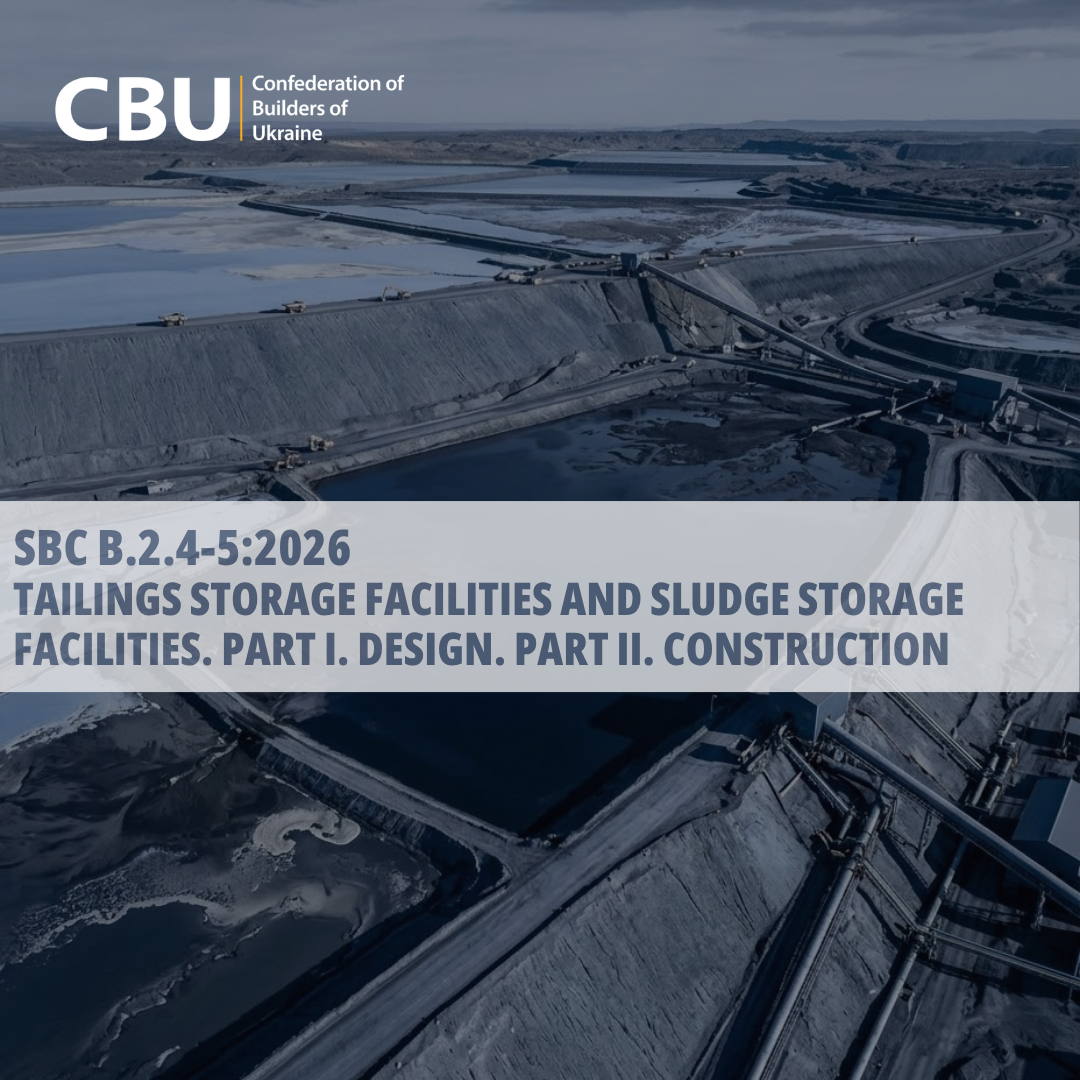
🪨 Updated Design Standards for Tailings and Sludge Storage Facilities
Starting from June 1, 2026, SBC V.2.4-5:2026 “Tailings Storage Facilities and Sludge Storage Facilities. Part I. Design. Part II. Construction” will come into force, fully replacing the previous SBC V.2.4-5:2012.
📍 The updated version modernizes the regulatory framework (eliminating outdated SNiP standards), introduces European approaches, provides more detailed requirements for technical and engineering systems, strengthens safety, monitoring and environmental provisions, and implements a performance-based (parametric) approach to standardization.
Key changes compared to SBC V.2.4-5:2012:
🔹 Introduction of monitoring requirements (Section 5.12.2) — design documentation must include systems for monitoring deformations, filtration processes, and water levels, as well as defined observation points and control parameters.
🔹 Enhanced anti-filtration measures (Section 5.5) — requires a justified selection of structures and materials to prevent soil and groundwater contamination, taking into account site-specific geotechnical conditions.
🔹 Detailed technologies for tailings preparation and storage (Sections 5.7, 5.9) — separately regulates thickening, dewatering, and transportation processes, as well as storage methods, including modern technological approaches.
🔎 The updated SBC significantly strengthens environmental requirements (Section 5.13). It provides detailed provisions for dust suppression and mitigation of wind erosion, as well as for defining sanitary protection zones and safety buffer zones. Particular attention is given to the organization of recirculating water supply systems to minimize environmental impact. Design solutions must also be aligned with Environmental Impact Assessment (EIA) procedures.
📋 The approach to reliability has also been reinforced through a clear determination of the consequence class (CC1–CC3). This classification directly affects dam design requirements, calculation parameters, engineering systems, and the level of technical control. Facilities with higher consequence classes are subject to increased safety factors, mandatory monitoring systems, and stricter safety requirements. The consequence class must be technically and analytically justified within the design documentation.
🧩 In addition, the updated standard expands the scope of engineering systems to be included in the design. Tailings facilities are now considered as integrated engineering systems that include power supply, electrical equipment and lighting, dispatching and control systems, as well as communication and alarm systems. This requires full integration of all engineering disciplines within the project and ensures their coordinated operation in accordance with the defined consequence class.
👇 The full document is available at:
https://e-construction.gov.ua/files-token/63a4c4c20f23b6e4194e8e1e175159ea
WE WILL WIN AND REBUILD EVERYTHING! 💪
TOGETHER TO VICTORY!
GLORY TO UKRAINE! 💙💛