



 Monday, 25 December 2023 15:11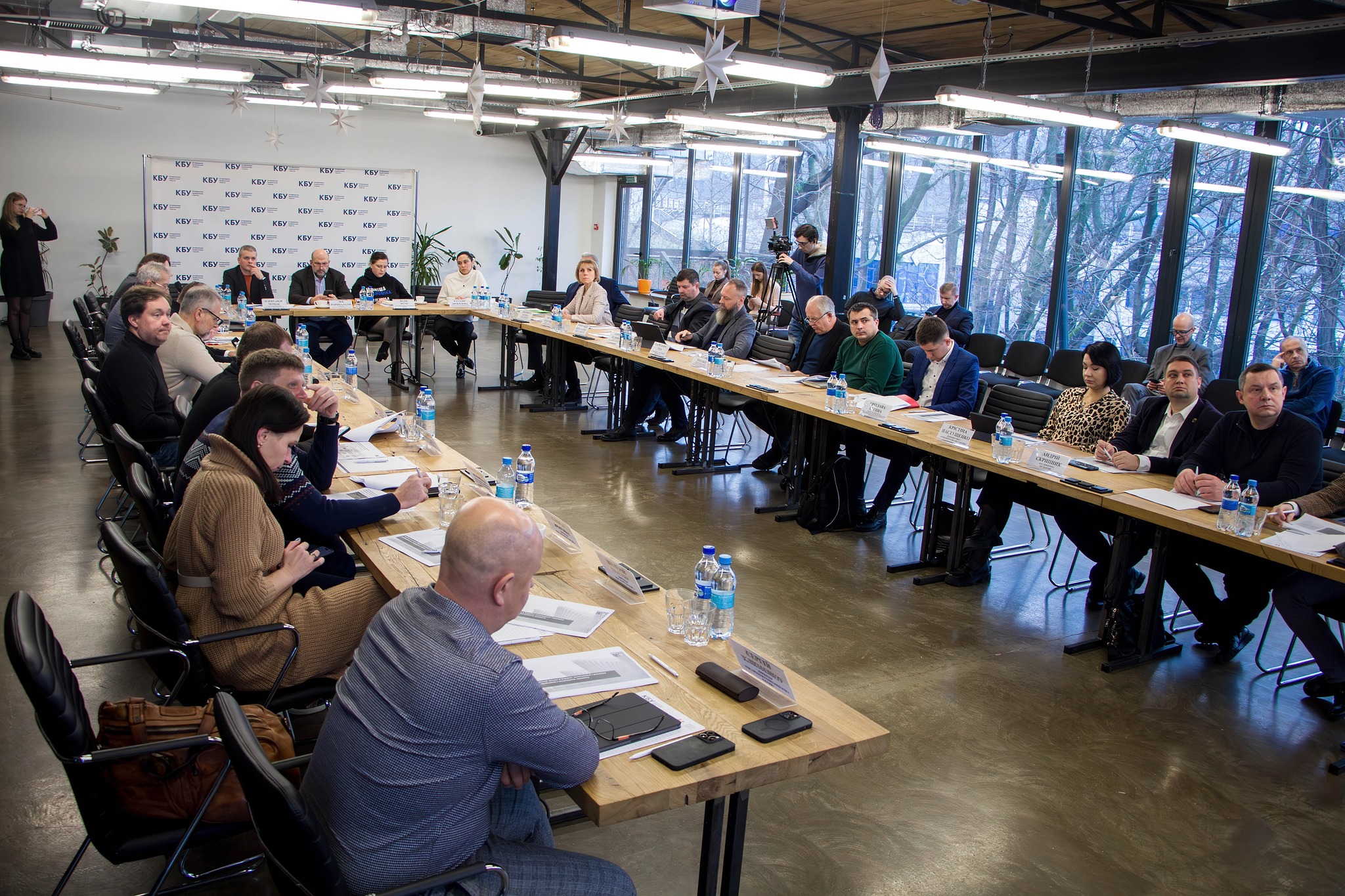
🌐 On December 19, 2023, a roundtable discussion "Cement: opportunities and challenges for producers and consumers" was held to analyze the Ukrainian cement market and the needs of the future reconstruction of Ukraine.
During the roundtable discussion, the participants, in particular, representatives of the authorities, relevant stakeholders of the state and private sector got acquainted with the overview of the building materials industry of Ukraine, namely the cement market.
👤The discussion was moderated by Lev Partskhaladze, President of the CBU. He congratulated all participants and emphasized the importance of the meeting: "We understand that there will be large-scale reconstruction in Ukraine and the construction business must be ready for all challenges. That is why the CBU gathered representatives of the construction industry today in order to better understand the situation, how ready the country is for reconstruction, what are the problems today and what should be prepared for."
👤Tetiana Sytnyk, Head B2B and Strategic Research CBR presented a review of the cement market of Ukraine, commissioned by the Confederation of Builders of Ukraine, which reflects the current state of the cement industry and the barriers that prevent its development. She named 3 groups of challenges faced by business today: adaptation to current conditions, provision and planning of reconstruction and implementation of European standards.
📊According to her, about 35 million tons of pure cement will be needed to restore Ukraine destroyed during the war. This makes cement a key reconstruction material, the speed of recovery depends on the availability of cement. Currently, the production capacity of existing enterprises is about 13.6 million tons per year.
📊Tetiana Sytnyk noted that over the past 10 years, the share of construction in the GDP varied from 2% to 4%, but this share should grow in the process of reconstruction. According to her, today the cement market is represented by 5 large plants with a full production cycle, 1,800 companies of direct buyers and thousands of construction and trade enterprises.
📊Also, the trend towards growth in portland cement production during 2014-2020 and a maximum in 2021, namely 11 million tons, was presented. Cement consumption also peaked in 2021. Since consumption volumes exceeded production volumes, the needs were partially compensated by imports. "Export and import are ways of balancing the market," noted Tetiana Sytnyk.
The CBR representative noted the high concentration of the cement market in Ukraine: "Compared to other countries, the concentration is also high in Poland, but low in Turkey, where there are many producers."
👤 Nadiya Bihun, Deputy Minister of Economy of Ukraine, noted that the Ministry of Economy of Ukraine focuses attention on industries that provide a large added value, that is, on production. "Ukraine is a large country both in terms of population and territory, but the economic situation is not the same everywhere," noted Nadiya Bihun. - When the security situation permits, many restoration projects will be implemented. But needs and demand will not be the same. The southern and eastern regions will be restored. The question is whether our production structure allows us to direct resources effectively."
The Deputy Minister talked about the growth of GDP and emphasized that next year it is planned to increase the financing of the security and defense sector, namely the construction of fortifications. Construction equipment and materials will be in particular need.
Nadiya Bihun also talked about programs that should support manufacturing businesses. This includes lending under the preferential program "5-7-9" and returning 25% of the cost of purchased Ukrainian-made agricultural machinery: "If we manage to find additional financing, we may expand to other types of Ukrainian-made machinery. Grants for processing - that is, production - will also be extended."
👤Olena Shuliak, Head of the VRU Committee on State Building, Local Governance, Regional and Urban Development, Head of “Servant of the People”, emphasized the importance of supporting Ukrainian producers and entrepreneurs: "International partners finance the social sphere, can provide weapons, but all military needs are provided by our business".
Olena Shuliak recalled the logistical challenges of today and the beginning of official negotiations on joining the European Union. So, the 305 regulation has been implemented, but the standards must work before the cement market is open to all.
💬"Defense and Victory first, and then recovery expenses. However, there are programs that stimulate construction now," said Olena Shuliak. She spoke about the provision of compensation for destroyed or damaged housing, so, payments are already being made for current repairs, the exchange of certificates is now starting, and in January people will be able to rebuild private houses on the territory where they were destroyed.
Separately, Olena Shuliak noted the importance of taking into account the interests of producers, consumers of building materials and society.
👤During the discussion, the issue of supervision in the field of construction materials was discussed. Natalia Diuzhylova, Deputy Head of the State Inspection of Architecture and Urban Development of Ukraine, spoke about the problem of access to construction product standards for inspectors and market representatives: "In the cement industry, the entire base of standards is prepared for work, but inspectors cannot get acquainted with the texts of the standards. For example, in Lithuania they are presented in the library in the reading mode. This is an intellectual work, and it cannot be made freely available, but it can be presented on the premises of the library. Inspectors should get acquainted with the regulatory standards, study them and work with these documents”.
💬Natalia Diuzhylova described how the inspection is carried out: "There is a Law of Ukraine "On State Market Supervision and Control of Non-Food Products", according to which the subject of the inspection is the distributor, which is responsible for the products it provides."
👤Sergii Pylypenko, Chairman of the KBU Committee on Construction Products, Deputy Chairman of the Board of Directors of the CBU, CEO of Kovalska Group, member of the Board of Directors of the CBU, characterized the cement market in Ukraine: "Without cement, no large-scale projects are carried out. I feel the risk of shortages based on studies of damage levels and construction needs. In 2021, enterprises reached their peak and produced 11 million tons of cement. But we see that production has stopped in Balaklia, and it is not working in Mykolaiv either. However, last year's dynamics show that the market is recovering. About 7 million tons are expected this year."
He noted that bank programs do not allow attracting funds for investments in the creation of new production facilities, and the Ukrainian investor does not have such a volume of funds: "These are hundreds of millions of dollars. Perhaps it is worth creating long-term financing programs under market conditions within the framework of “investment-nanny” or industrial parks."
👤 Oleksandr Melnychenko, acting Executive Director of UkraineInvest, reminded that this year the Verkhovna Rada of Ukraine adopted draft law №9015 "On Amendments to the Law of Ukraine "On Financial Mechanisms for Stimulating Export Activities" regarding the insurance of investments in Ukraine against war risks", the so-called "investment-nanny".
💬"UkraineInvest actively promotes this law. We work with the international community, we provide informational support, we work as investment nannies, - told Oleksandr Melnychenko. - We promote Ukraine's investment attractiveness even in wartime conditions."
👤Svitlana Berzina, President of the NGO "Living Planet" - Executor of the GIZ Project, described the reforms that will be implemented in the near future in the field of ecology and that will have an impact on the cement industry: "In the plans of the Profile Committee of the VRU and the Ministry of Environmental Protection and Natural Resources of Ukraine, the promotion of laws, which should be adopted within the framework of the Association Agreement between Ukraine and the European Union. This is pollution prevention, CBAM - "carbon tax", greenhouse gas trading market, draft Law on State Environmental Control №3091".
Separately, the participants discussed the significance of railway logistics routes for the Ukrainian economy and the initiative implemented by Ukrzaliznytsia.
👤Pavlo Kachur, President of the "Ukrcement" Association, noted that production is at its peak, as there is demand. In his opinion, the beginning of reconstruction will be long-term, so in Serbia and Macedonia construction has reached high indicators in 4 years. He noted the role of anti-dumping protection in maintaining healthy competition and emphasized: "Reconstruction will be a chance if we rely on our own building materials and labor force."
Pavlo Kachur drew the attention of the participants to the increase of the cost of cement production: "The price of electricity increased by 200% from 2020 to 2023, coal - by 283%, transportation - by 317%, and transportation and energy carriers - this is 72% of the cost of cement."
👤Volodymyr Vlasyuk, Director of the State Enterprise "Укрпромзовнішекспертиза" (Ukrainian Industry Expertise), noted that construction can have a significant impact on the economy, as it has a large internal component, unlike other industries, but there is a problem of low capacity utilization.
👤Andrii Skrypnyk, acting director of "Ukrainian Research and Design Institute of Building Materials and Products", described three scenarios for the development of cement market needs: "According to our estimates, the minimum pessimistic figure for the reconstruction period is about 20 million tons. Probable estimates are 30 million tons. And we will not talk about the optimistic ones, although some Europeans estimate it at 90 million tons. But we understand that this is unrealistic."
The obtained analytical data will allow to qualitatively form a policy of support for the construction materials industry and to attract additional investments.
The CBU is open for cooperation in order to conduct a permanent constructive dialogue for the future reconstruction of Ukraine.
WE WILL WIN AND REBUILD EVERYTHING!💪
TOGETHER TO VICTORY!
GLORY TO UKRAINE!💙💛