



 Thursday, 19 February 2026 09:52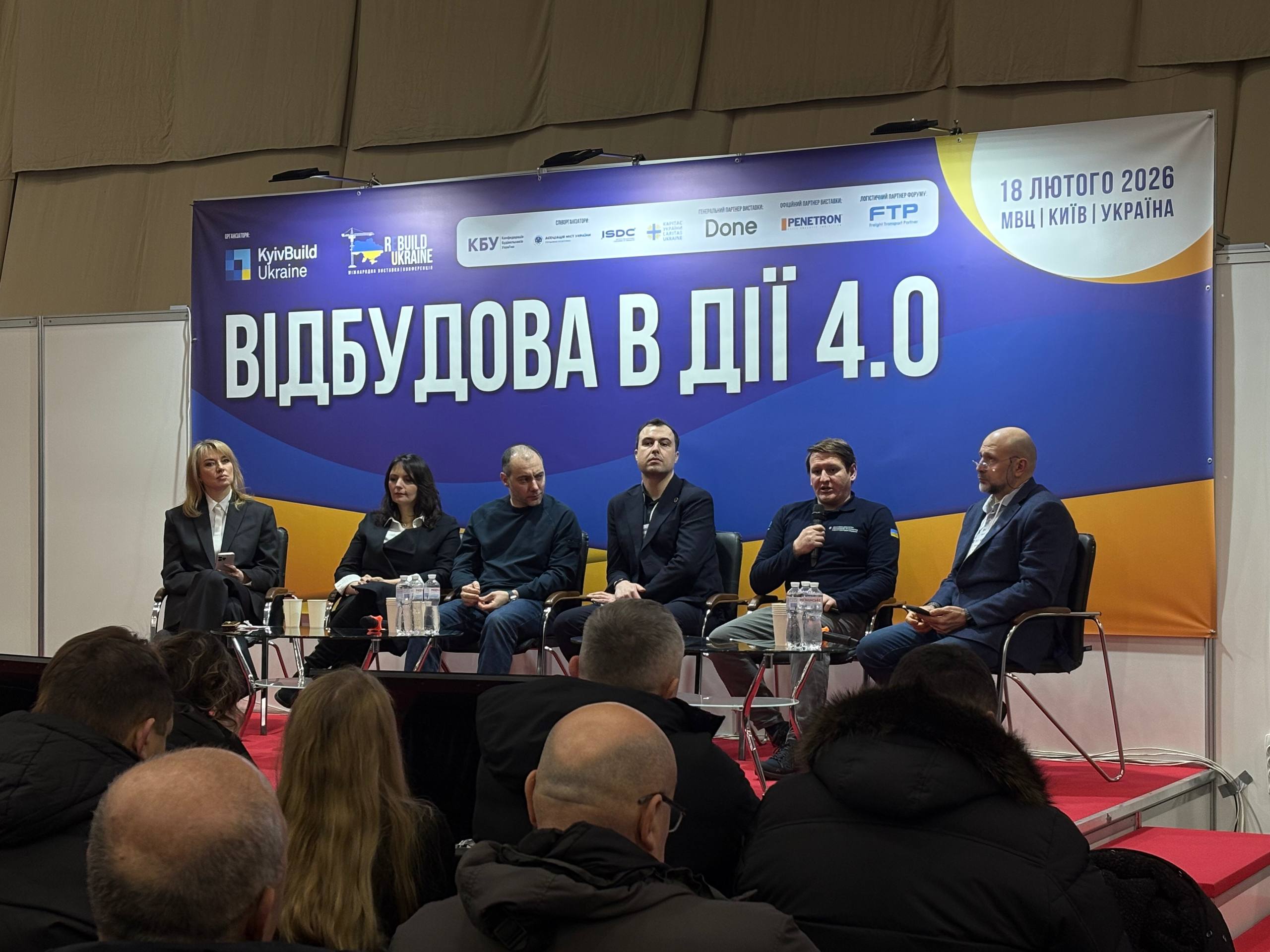
🏘️ Reconstruction Policy 2026
📣 Strategic priorities for infrastructure reconstruction and strengthening community capacity, transparency in tender procedures and priority reconstruction projects, market surveillance of construction products, and corruption risk management in the context of large-scale reconstruction in Ukraine These and other issues were discussed during the thematic panel “Reconstruction Policy 2026,” which took place on February 18 as part of the Forum-Workshop “Reconstruction in Action 4.0” at the KyivBuild Ukraine 2026 International Construction Exhibition.
Opening the forum, Yaroslav Yashchenko, Director of the KyivBuild exhibition, welcomed all participants and wished them a constructive dialogue.
💬 "The world has already gone through large-scale reconstruction, and we should learn from this experience. What all successful reconstruction cases have in common is a clear strategy, transparent rules, and a long-term vision. Reconstruction is not just about square meters. It is about the economic model, quality of management, and trust", emphasized Lev Partskhaladze, President of the CBU, at the start of the panel. He also expressed his gratitude to Premier Expo for organizing the forum, which brought together representatives of government, communities, and business.
Olena Shulyak, Chair of the Verkhovna Rada Committee on Organization of State Power, Local Self-Government, Regional Development, and Urban Planning, outlined legislative initiatives in the field of construction and reconstruction.
💬 "We are forming a new model of housing policy—with the introduction of social and affordable housing operators, clear rules for social rental, and transparent financial mechanisms. Housing policy is no longer situational but institutional. It is this model that creates predictability for communities, investors, and international partners", said Ms. Olena.
In 2026, the key areas of work for the Verkhovna Rada Committee on Organization of State Power, Local Self-Government, Regional Development, and Urban Planning remain:
🔹 social housing fund;
🔹 housing stock management;
🔹 regulation of the rental market and professional real estate activities;
🔹 preparation of legislation on housing and construction companies;
🔹 formation of mechanisms for state and local guarantees to attract investment.
💬 "Today, communities are one of the key customers and drivers of reconstruction - their share in the implementation of infrastructure projects already exceeds 50%. At the same time, international support must be integrated into systematic approaches that cover the entire project life cycle - from planning to implementation and monitoring. Our task is to strengthen the capacity of communities to effectively manage these processes and ensure the transparency and sustainability of recovery", said Oleksandr Kubrakov, Advisor to the President of Ukraine on Infrastructure and Community Relations.
According to him, the priority infrastructure areas in 2026 remain electricity, water, and heat supply for communities with critical needs, as well as the introduction of alternative energy sources.
💬 Oleksandr Novytskyi, Head of the State Inspection of Architecture and Urban Planning of Ukraine, emphasized the role of market surveillance of construction products: "Market surveillance of construction products is a new and important area of state policy, introduced in accordance with the requirements of the European Union and as part of Ukraine's European integration. Systematic inspections in this area began on January 1, 2021. These requirements apply to all market participants - manufacturers, importers, distributors, and consumers. After the moratorium on inspections was lifted in 2025, scheduled control measures were carried out, and this area will remain one of the priorities for ensuring the quality and safety of construction products on the market."
Yuriy Sverba, Deputy Head of the State Agency for the Restoration and Development of Infrastructure of Ukraine, outlined the transparency and control tools already in place to minimize risks in public procurement in the field of reconstruction and the criteria that form the list of priority reconstruction projects.
💬 "Our task is to make the procedures for implementing infrastructure projects economically sound and transparent. The updated approaches involve moving away from the practice of formally limiting profitability at the level of administrative indicators, as businesses cannot operate effectively in such conditions, especially when implementing large-scale reconstruction projects. At the same time, the resolution on pricing introduces the formation of an objective market-based price base for materials and resources, which will allow for the justification of estimates, minimize disputes during audits, and increase the transparency of the use of funds", emphasized Mr. Yuriy.
📋 He noted that during the implementation of protective infrastructure construction projects, ensuring a balance between security requirements and the need for openness became a particular challenge. In order to increase transparency and trust on the part of citizens and international partners, an open weekly dashboard was introduced, which contains summary information on the volume of work performed, contractors, regions of implementation, and the cost of basic construction materials. Only general price indicators that do not pose security risks are disclosed, but at the same time allow for control over the use of funds.
Tetyana Korotka, Deputy Business Ombudsman, spoke about practical tools for compliance and business risk management that should be implemented for participation in recovery projects.
💬 "The scale of reconstruction will require Ukraine to make quick and systematic decisions, but high-quality project preparation and transparency of procedures must remain key conditions for success. It is important for the state to eliminate shortcomings at the planning and documentation preparation stages, and for businesses to critically assess their participation and not get involved in projects that lack transparency or proper justification. Reducing corruption risks is a shared responsibility that begins with internal standards and the principled position of the companies themselves", emphasized Ms. Tetiana.
🚍 Tetiana Gorgo, Head of Construction Materials Supply at FTP, spoke about the impact of logistics on the final cost of a project. She noted that the cost of transporting materials, equipment, and components often accounts for a significant portion of the budget, and delays in delivery or downtime at the site can significantly increase overall costs. Effective logistics planning, route optimization, and the use of local resources can reduce costs, shorten construction time, and increase the economic efficiency of the project.
Organizers of the forum-workshop: ReBuild Ukraine and KyivBuild Ukraine 2026.
WE WILL WIN AND WE WILL REBUILD EVERYTHING! 💪
TOGETHER TO VICTORY!
GLORY TO UKRAINE! 💙💛