



 Tuesday, 15 July 2025 11:23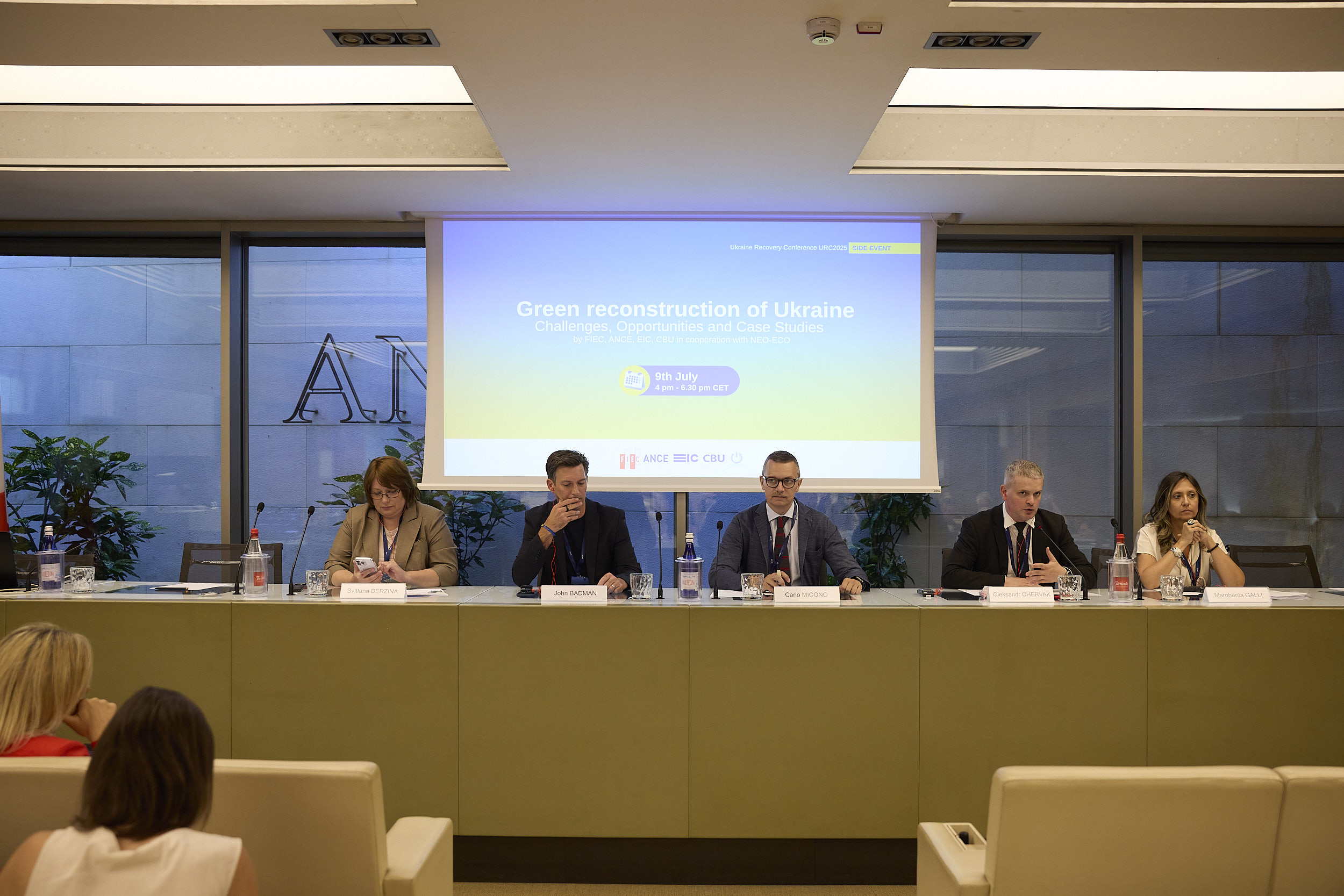
🏗️🌿From Housing to Resources: How Green Reconstruction is Being Implemented in Ukraine
Current construction projects for Ukraine’s recovery and practical case studies were discussed during the panel discussion of the special event “GREEN RECONSTRUCTION OF UKRAINE” held as part of the Ukraine Recovery Conference 2025.
💬“If we compare Ukraine to other countries, it turns out — and this may surprise you — that many of the things we are talking about are already present in Ukraine. We are already implementing them, and in some cases, we may even be ahead of other countries. However, due to the war, these innovations lack a systemic character. Therefore, the goal of the CBU, as the largest construction association in Ukraine, is to accelerate this process through dialogue between business and the government,” noted Oleksandr Chervak, CEO of the Confederation of Builders of Ukraine and moderator of the discussion.
🏘️One example of applying environmental principles in reconstruction is the Tetiiv ECO Neighborhood. The project was presented by Carlo Micono, AiStudio.
This project is designed to be a place to live, grow, and develop for all people affected by the war.
💬“We are not just building housing. The project is about people. And this is the main idea we invest in the project: safety, accessibility, employment, community, education, resilience,” emphasized Carlo Micono.
The project is structured to minimize energy demand and maximize building efficiency. As a result, the buildings are 70% more efficient than new residential constructions in Europe; CO₂ emissions are reduced by 40%; and up to 65% self-sufficiency is achieved through photovoltaic systems.
🌳Opportunities for reuse projects in green reconstruction were outlined by Svitlana Berzina, President of the All-Ukrainian NGO "Living Planet".
💬“We were inspired by the well-known green building standards and, based on them, at the request of the Ministry for Communities and Territories Development of Ukraine, we developed a national version of the standard, which defines environmental criteria and a method for assessing public buildings,” shared Svitlana Berzina.
The standard provides for the evaluation of improved environmental performance of public buildings and facilities at all stages: design, construction, commissioning, operation, renovation, and decommissioning.
The criteria include: management, infrastructure and sustainable territorial development, indoor comfort and safety, waste management, environmental protection, life safety, construction materials, water efficiency, and energy efficiency.
💬“It is very important for us to conduct training, exchange experiences, and utilize the potential of Italy, which is a leading country in the field of green construction. Because we lack this knowledge and these skills,” stressed Ms. Berzina.
She also shared details on the development of green reuse projects. Last month, CBU and "Living Planet" signed a Memorandum that provides for the integration of these projects into the “Architectural Navigator” initiative.
♻️Waste Can Become a Resource for Ukraine’s Green Reconstruction
Participants were informed about the relevant EU LIFE Debris2Resource project — by Margherita Galli, Green Building Council Italy.
The project envisions cooperation between European and Ukrainian stakeholders to address waste management challenges and is scheduled to launch in December 2025.
💬“The goal of the project is to exchange experience and best practices. One of the best practices from Italy that will be used in the project is a business model for waste management — to facilitate the collection and recycling of construction and demolition waste,” shared Ms. Galli.
The project aims to establish a replicable methodology for construction debris management to enable circular disposal and reuse of construction waste, with a focus on sorting materials such as crushed concrete, iron, wood, and hazardous substances.
🌇John Badman, Residential Practice Area Lead at Gensler, shared details of the Norman Foster Competition for Kharkiv and presented the Saltivka reconstruction project.
It is important to note that while some buildings were destroyed and demolished, others are still suitable for restoration. In addition, there are plans to reimagine the surrounding space, considering the current conditions and all residents’ needs.
The plan is to repair damaged buildings, construct new ones within a comprehensive master plan, and reconnect people through public space — ultimately creating an integrated and cohesive community.
💬“We worked with the Neo-Eco team to develop an innovative way to use debris from demolished buildings — to clean, sort, and transform it into easily assembled masonry made from bricks and blocks for foundations and load-bearing walls of low-rise buildings,” said John Badman.
Another important element of the project is the creation of green areas, designed to gather and unite the district’s residents.
Read more details from the special event at the link:
https://kbu.org.ua/en/news/european-solidarity-and-sustainable-development-of-ukraine
WE WILL WIN AND REBUILD EVERYTHING! 💪
TOGETHER TO VICTORY!
GLORY TO UKRAINE! 💙💛